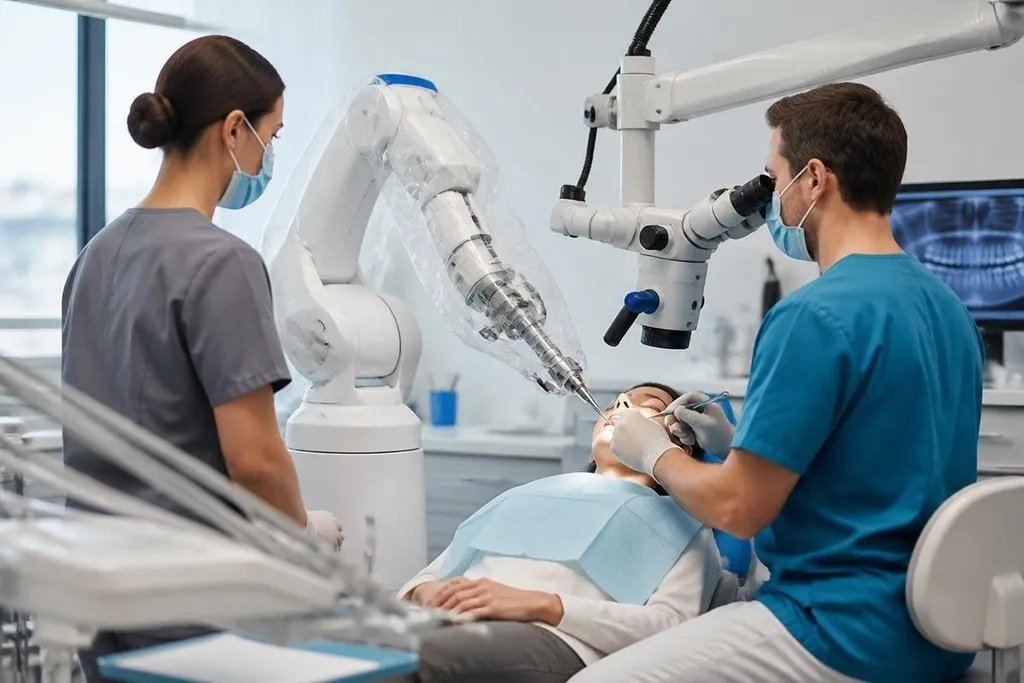
A dental robot can guide a drill, hold a tool, or help a dentist place an implant. The hard part is showing that it improves care without adding new risks, delays, or costs.
If you’re assessing dental automation, start with the evidence behind the claim. A polished demo can show movement; it can’t show how the system performs across real patients and difficult cases.
- Ask which part of the procedure the robot handles.
- Demand results from real clinical use, not a staged motion test.
- Check who remains responsible when the system stops or makes an error.
What the robot would actually do
Dental robotics can cover several different jobs. A system might guide a tool along a planned path, hold a camera during imaging, or help a dentist keep an implant position within set limits.
Those tasks need different tests. A robot that holds a steady position has a different safety case from one that moves a drill near bone, nerves, or soft tissue. Treating both as the same product hides the part that matters most.
The dentist also remains part of the process. A useful system should let them pause, change, or stop the movement without waiting for software or a remote operator.
That control matters when a patient moves, visibility changes, or the planned path no longer fits the mouth in front of the dentist.
The evidence that matters
The first useful number is the number of procedures completed with the system. Ask for the procedure type, the number of patients, the time period, and the result measured in each case.
Procedure time needs context too. A robot may shorten the drilling step but add time for scanning, setup, calibration, cleaning, and staff training. The only number that helps a clinic is the full time from patient preparation to room reset.
Accuracy also needs a clear reference point. A claim such as “within a fraction of a millimeter” has little value until the maker states how that distance was measured, who checked it, and how often the system missed its limit.
A fraction of a millimeter matters only if the patient, tool, and procedure match the test conditions. For a clinic comparing systems, dental robotics reporting from Robot24.com adds the procedure, operator, test date, and result beside the accuracy claim. The harder check starts where that number ends: what happens when the patient moves?
Where the limits sit
The system works from sensors, software, and a plan. Each part can fail. A scan can contain an error, a patient can move, or an instrument can meet resistance that the original plan did not include.
The system should show what happens next. Does it stop on its own? Does it warn the dentist? Can the dentist take over at once? The maker should explain those steps in plain language and test them under conditions that match the clinic.
Training is another cost that product videos often leave out. Staff need time to learn setup, cleaning, fault checks, and manual operation. A clinic also needs a plan for work when the robot is offline, being serviced, or waiting for a software update.
Price claims need the same care. The purchase figure may exclude installation, service, disposable parts, software fees, training, and changes to the treatment room. Without those numbers, no clinic can compare the robot with its current process.
I’d wait for published clinical results and full operating costs before buying a dental robot for routine work.
A clinic’s decision checklist
Use these questions before asking for a trial or signing a purchase order:
- Procedure scope: Which exact step does the robot perform, and which steps stay manual?
- Clinical record: How many patients have used it, for which procedures, and with what results?
- Safety control: Can the dentist stop and move the tool by hand without delay?
- Total cost: What do installation, service, software, training, and consumables add?
- Failure plan: How does the clinic continue treatment when the robot is unavailable?
- Staff workload: How much setup, cleaning, checking, and retraining does each case require?
A dental robot earns a place in a clinic when it gives the dentist better control or repeatable results at a known cost. Until makers publish that evidence, the sensible next step is a supervised trial with clear measures for time, accuracy, safety stops, and patient outcomes.